by In Koo Kim Last Modified May, 2026
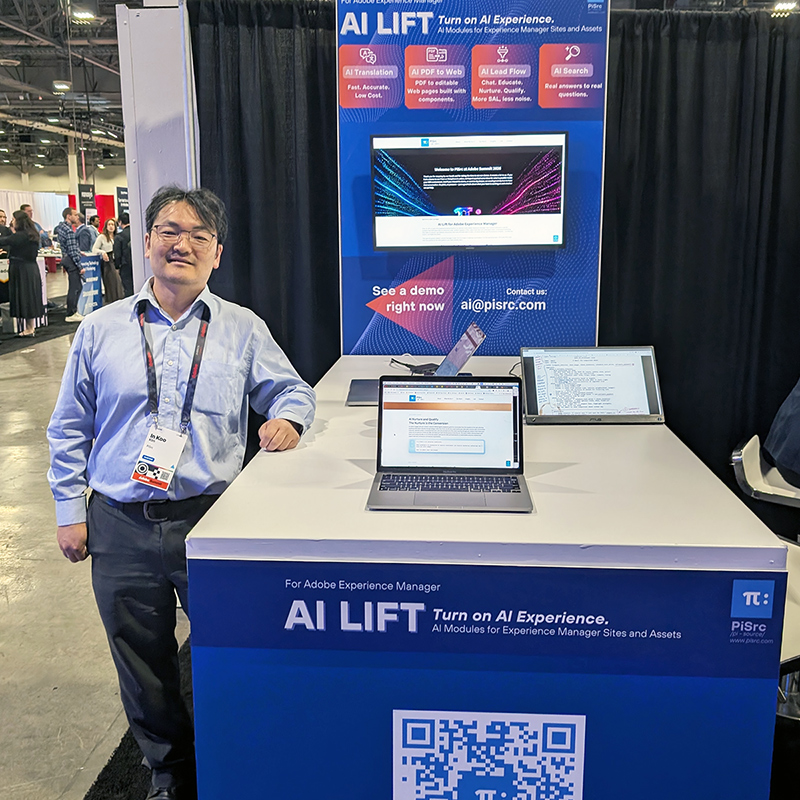
I spent three days at Adobe Summit 2026 in Las Vegas last week. By the end of the first afternoon, I had developed a small game: walk a row of the partner pavilion and count how many booths did not have the word "AI" somewhere on their signage or booth. The number was almost always zero (PiSrc was no exception).
The exception, on one particular row, was a small custom sticker printer. They were quietly running a press, taking custom orders, and producing high-quality vinyl decals while everyone around them was pitching agentic copilots. I bought a set of PiSrc stickers from them. They were genuinely the most refreshing booth in the building, and not despite the absence of AI in their pitch, but because of it. They were doing one thing well, with no acronyms, and I left with something I could actually use that day.
The sticker company was an outlier. Everyone else was selling AI. Or, more precisely, everyone else was selling something that already existed last year, with AI features bolted on. AI in your search bar. AI in your form analytics. AI in your sales engagement tool. AI in your content recommendations. AI in your DAM. AI in your campaign builder. The pattern was so consistent that the absence of AI on a booth started to feel like a product positioning decision, not an oversight.
There is nothing wrong with adding AI to existing products. The capabilities are real, the engineering work is genuine, and many of the features deliver value on day one. The problem is what happens to the buyer who treats those features as their AI strategy.
Several large incumbent platforms across martech, search, sales engagement, content management, and CRM have shipped AI features in the last twelve months. The patterns repeat: semantic search and natural-language Q&A inside an existing search product, AI overviews in result pages, conversational lead-qualification chat with avatars on top of an existing engagement product, AI-driven content recommendations inside an existing personalization product, generative summarization inside an existing knowledge base. The acquisitions have followed the same pattern. A category-leading platform buys an AI-native point solution and folds it into the suite as a feature.
For the platform vendor, this is sound strategy. They get to defend their existing customer base, expand their average contract value, and reposition their product as agentic without having to rebuild from the ground up. For the buyer, the value proposition is straightforward: turn on a feature, get AI capability, no engineering investment required. The check is one more line item on a renewal that was probably going to happen anyway.
That trade looks attractive in the short term. The product team gets to demonstrate AI adoption to leadership. The marketing team gets new capabilities to feature in launch decks. The procurement story is simple. And in many cases, the feature genuinely improves the product. None of this is wrong. The risk is in mistaking the transaction for a strategy.
What gets traded away is not visible in the contract. It is the internal capability that would have been built if the AI capability had been developed rather than purchased. When a platform vendor delivers AI as a feature, several decisions are already made on your behalf. The underlying model is theirs. The retrieval layer, if there is one, is theirs. The way agents are structured, the tools they call, the guardrails that constrain them, the prompts that govern their behavior, the monitoring and analytics around their performance: all of these are encapsulated inside the vendor's product. Your team learns to configure them, not to build them.
Configuration is not a substitute for capability. A team that has learned to administer a vendor's AI feature has not learned how vector search behaves under different chunking strategies, has not chosen between embedding models for a specific domain, has not designed an agentic loop with explicit planning and tool selection, has not written guardrails that reflect their organization's specific risk posture, has not stood up evaluation infrastructure that lets them test changes with confidence. Those skills compound across deployments. Configuration knowledge does not. It is specific to one product and evaporates the moment the contract ends.
The architectural decisions also compound. An organization that has built one production AI workflow with its own retrieval layer and its own model endpoint has, at minimum, a partial blueprint for the second workflow, the third, and the tenth. An organization that has subscribed to one AI feature inside one platform has the same blueprint as every other customer of that platform, which is to say, they have none.
The white paper, Built to Evolve: Staying Ahead When AI Keeps Moving, laid out a principle for production AI: festina caute, make haste carefully. The argument was that the market moves at the cadence of model releases and architectural shifts, and the organizations that win are the ones whose systems can absorb each shift on the timeline of the technology rather than the timeline of a rebuild. Test infrastructure was the engineering property that made that possible.
Vendor-bundled AI features create a different problem. Your AI roadmap is no longer your roadmap. It is your vendor's roadmap. The model your AI feature runs on shifts when your vendor decides to shift it, on whatever testing schedule they apply, with whatever rollout strategy serves their installed base. The tool integrations available to your AI agent are the integrations the vendor has prioritized, not the ones your business needs. The guardrails and policies are designed for the median customer of that platform, not for the specific governance posture of your organization. When a new frontier model lands and demonstrably improves the workload your AI is doing, you cannot adopt it on your timeline. You wait.
In a market where the leading edge moves every few months, waiting compounds. A platform that was AI-leading in 2025 can fall a release cycle behind in 2026 and never catch up, because catching up requires rebuilding the foundation while continuing to ship the feature. Your dependence on that vendor's velocity becomes a strategic liability that does not show up on any architecture diagram.
The same applies to model failure modes. When a new vulnerability class is documented in security research, an organization with internal AI capability can red-team their own deployment against the new attack pattern within days. An organization whose AI sits inside a vendor's product has to wait for the vendor's response, which may or may not be timely, and may or may not be transparent. Or worse, you may simply receive a breach notification weeks later with no clarity on what was exposed.
A concrete example of why this matters arrived in early April 2026. Anthropic released Claude Mythos Preview, a frontier model with markedly stronger capabilities at finding and exploiting software vulnerabilities than any prior public model. Anthropic distributed access to a small group of major tech and infrastructure companies, with the explicit goal of giving defenders a head start before models with similar capabilities become broadly available. Claude Mythos Preview found a 27-year-old vulnerability in OpenBSD, a 16-year-old bug in FFmpeg that automated tools had hit five million times without catching, and chained Linux kernel vulnerabilities into a privilege escalation.
The strategic question for an enterprise is not whether Mythos is a watershed. It is what to do about it. Two postures are available.
The first is passive: trust that the existing security stack (firewalls, endpoint protection, vulnerability scanning, patch management) will hold against adversaries augmented by frontier models. This posture has obvious problems. The defenses currently in place were designed against attackers operating at human speed and human cost. A model that can grind through tedious exploitation steps at machine speed and effectively zero marginal cost changes the economics of every defense whose value comes from friction rather than hard barriers.
The second posture is active: deploy the same class of model in your own defensive workflows. Use it to find and triage vulnerabilities in your own code before adversaries do. Use it to evaluate the security posture of your AI deployments themselves, including prompt injection surface area and tool-call boundaries. Use it to harden the reasoning behind your guardrails, which were probably written before this generation of capability existed.
The active posture requires internal AI capability. It requires the ability to integrate a frontier model into a workflow that touches your code, your systems, and your data, under your governance, on your timeline. An organization whose AI capability is bundled inside a martech feature cannot do this. The model selection, the tool integrations, and the data access are all controlled by the vendor, and the vendor's product is not designed to be a defensive security workflow.
This is one specific example. The general pattern is that capability shifts of this kind will keep arriving. The organizations positioned to use each one are the ones with the internal infrastructure to deploy a model against a problem of their choosing, and a partner positioned to see the shift coming and help them act on it.
The phrase "internal AI capability" gets used loosely. To make it concrete, here is what we have built for enterprise clients in the last two years, the components that constitute a real capability rather than a procurement event.
A capability is not any one of these components. It is the team's ability to operate, evolve, and extend all of them together. That is what makes adoption of new models fast, deployment of new use cases inexpensive, and adaptation to the next architectural shift possible.
There is a real risk that an outside firm engaged to build AI capability becomes, itself, the capability. The client's AI runs because PiSrc built it and PiSrc maintains it. When PiSrc leaves, the system slowly degrades. That is consulting outsourcing dressed up as a transformation engagement. We do not do that work.
What we do is build inside the client's infrastructure, hand off operationally, and stay engaged strategically. Two things are true at once: the system belongs to the client, and the partnership keeps adding value long after the initial build. Both matter, and the engagement is structured to make both real.
For our enterprise engagement, what we build belongs to you.
The source code is yours. Every component we build, the agentic framework, the retrieval pipelines, the integration adapters, the guardrails, the evaluation harness, lives in your repositories from day one. We commit against your version control, follow your code review conventions, and document at the level of any production system your team will own.
The model instance is yours. We deploy against your Azure AI, AWS Bedrock, GCP Vertex, or other enterprise model environment. We do not run client AI workloads through PiSrc-controlled endpoints, and we do not insert ourselves into the inference path. If our engagement pauses, the model keeps running.
The integrations are yours. The connections to CRM, marketing automation, content management, knowledge base, and internal APIs are built using your authentication infrastructure, on your network, with credentials your team controls. There are no PiSrc-hosted middlemen in production traffic.
Knowledge transfer is structural, not gestural. Our engineers pair with your engineers throughout the engagement. Architecture decisions are documented as ADRs your team can read and challenge. Operational runbooks describe how to evolve the system without us. By the end of the initial build, your team is fully capable of operating and extending the system.
Owning the system is necessary. It is not, by itself, sufficient.
The pace of change in AI does not slow once your platform is in production. New models will land. New architectural patterns will gain traction. Some will become the standard. Others will fade. New attack techniques will surface. New regulatory expectations will arrive. The team that can operate and extend its own AI platform is well positioned, but no internal team can credibly track the entire frontier while also running the production system. That is where PiSrc continues to add value.
We live on the bleeding edge of AI development. Our engineers evaluate new model releases against real workloads, prototype emerging architectural patterns, track the security research, and run the experiments that separate signal from noise. By the time a new capability matters for one of our clients, we have already worked with it.
We filter the noise. Not every announcement is a shift. Most of what generates headlines in AI is either incremental, irrelevant to enterprise contexts, or actively counterproductive. Our value to a client is partly in what we tell them to do, and partly in what we tell them they can safely ignore. The cost of chasing every fad is real, both in engineering time and in technical debt. A partner with disciplined judgment about what merits a response is worth the engagement on that basis alone.
We help you pivot when shifts arrive. When a new model genuinely changes what is possible for a workload your platform handles, we are positioned to help your team evaluate, test, and adopt it on a compressed timeline. The companion paper described how test infrastructure makes that possible at the engineering level. The strategic version of the same property is having a partner who has already done the homework on the new capability before the question reaches your CIO.
We deepen the platform. New use cases, new domains, new agentic patterns, new integrations: the platform we build together is not finished at handoff. It is the foundation. Continued engagement extends what it does, often into adjacent functions and unexpected applications. Each extension reinforces the same internal capability rather than fragmenting it.
This is the difference between a capability accelerator and a capability landlord. PiSrc is in the first business, not the second. The system is yours. The runtime is yours. The decisions are yours. What we bring is the part that cannot be embedded in your repository: a continuous view of where the field is going, the discipline to help you act on what matters and ignore what does not, and the engineering depth to help you move when moving counts.
The last decade defined itself around digital transformation. The work was getting authoritative content out of disconnected silos, into structured platforms, exposed through APIs, and rendered through digital channels. Enterprises that took the work seriously came out with content management, customer data, and experience platforms that could actually serve their business. Enterprises that treated it as a series of tactical purchases ended up with a portfolio of point products that did not talk to each other.
This decade is defining itself around AI transformation. The work is putting an intelligent layer on top of all that infrastructure, an agentic capability that can read, reason about, and act on the systems that the prior decade put in place. Enterprises that take this work seriously will come out with internal AI capability that compounds across use cases and survives architectural shifts. Enterprises that treat it as a series of tactical AI feature purchases will end up locked into vendor roadmaps at the exact moment in history when the underlying technology is changing fastest.
Whatever the next transformation turns out to be, and there will be one, the property that matters is the same. Own enough of your stack to evolve it. Build internal capability that compounds. Treat speed and care as a single discipline rather than a tradeoff. And keep a partner close who is paid to look further down the road than your operational team has time to look.
Festina caute, applied not just to one model upgrade but to the whole arc of how an organization meets the next ten years of change.
PiSrc is here to build that capability with you, hand it to you, and stay alongside you while the ground keeps shifting. The system belongs to your organization. The partnership is what helps it stay ahead.
We hope that you have found this information helpful. Please message us with any questions or comments by using our contact form, and feel free to share with your peers.
