The AI landscape rewrites itself every few months. In four years the industry has moved through four distinct eras: from raw LLM chat, to retrieval-augmented generation, to formal guardrails, to agentic systems that plan and use tools. Each era recast what a serious enterprise deployment looked like. Major model releases marked the turns, opening up new options across the stack. The next era is already underway.
The organizations that win in this market are not the ones that bet correctly on a single architecture. They win because their systems can take in each shift as it comes. New capability arrives with the technology's schedule, not after a rebuild. This capability is engineered. It comes from disciplined testing practices borrowed from software engineering and applied to AI components with the same rigor: accuracy tests on known cases, regression tests against every change, and adversarial red teaming for unsafe behavior. Together these practices produce the confidence that lets a team adopt a new model in days, not months.
We call the principle festina caute: make haste carefully. Speed is non-negotiable in a market this fast, but recklessness in production AI is expensive. We reconcile these opposing pressures through engineering discipline. It keeps the system running release after release.
A new frontier model lands every few months. Each release changes the menu: better reasoning, extended thinking, longer context, cheaper tokens, new ways to call tools, native multi-modality. The capability that defined a state-of-the-art deployment a year ago can sit a tier below what a current-generation model delivers out of the box.
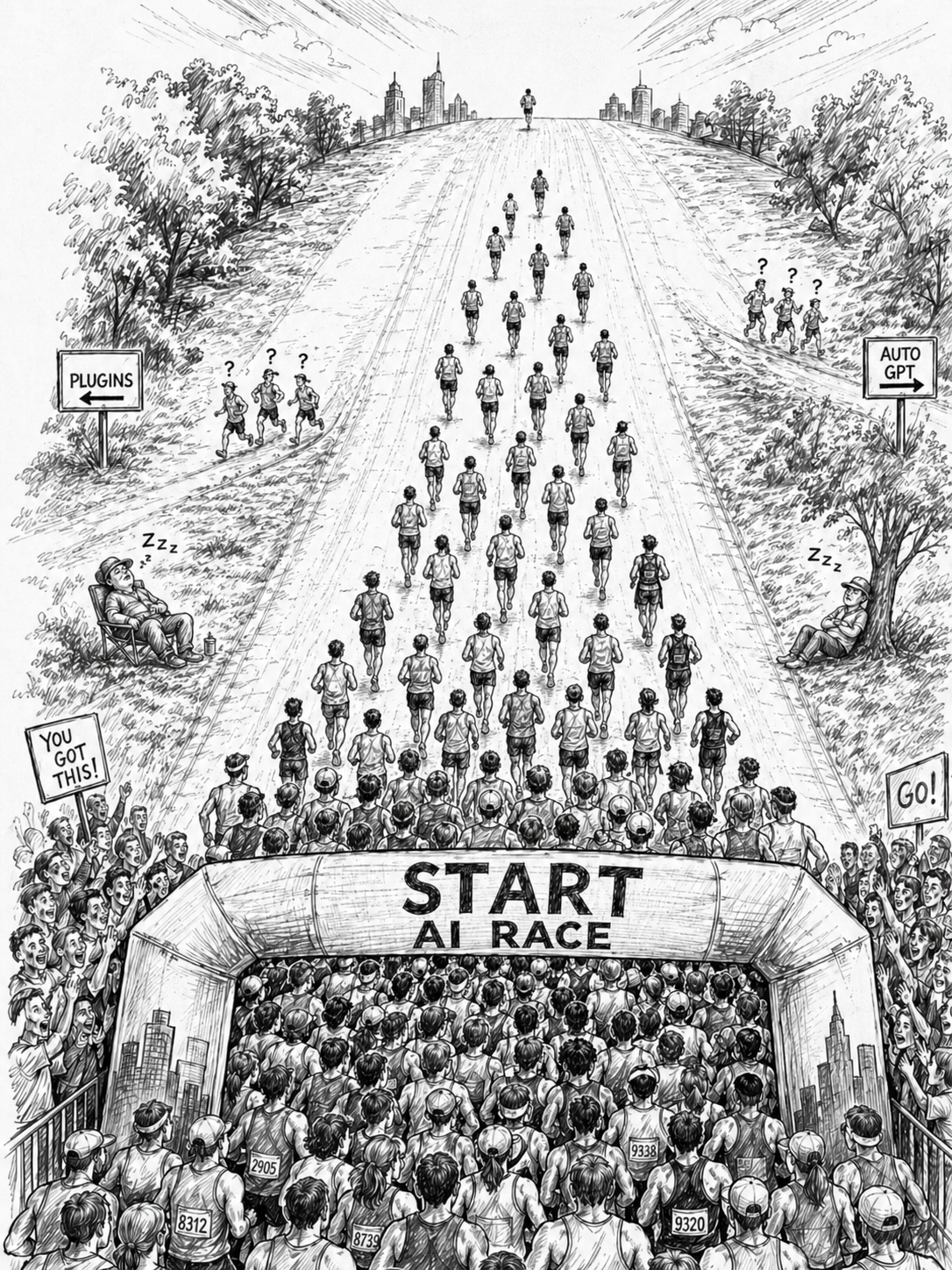
The pace of change is not just about model releases. The architectural patterns built around the models have been changing just as fast. In four years, the industry has moved through four distinct eras, with the next already taking shape.
The first was raw LLM chat. ChatGPT broke through in late 2022 and the operating assumption was that a sufficiently capable language model could answer most questions on its own. The deployments that came out of this era were chatbots wired to a system prompt and not much else. Hallucination was a known problem with no agreed solution. Enterprises piloted, marvelled, and mostly held back from production.
The second era was retrieval-augmented generation. Through 2023 and 2024, RAG became the differentiating pattern for grounding model output in proprietary content. Embedding pipelines, vector databases, and retrieval orchestration filled a real gap. For a stretch, RAG defined what a serious enterprise AI deployment looked like.
The third era was guardrails and governance. As production deployments began to face real consequences for unsafe or off-brand output, the industry moved from informal prompt engineering to formal output constraints, structured generation, content policies, and review workflows. Many of the deployments described in The Agentic Enterprise were built in this period, with explicit guardrails as a first-class part of the architecture.
The fourth, current era is agentic. Models now plan, use tools, and execute multi-step workflows under governed boundaries. Retrieval becomes one capability inside a broader orchestration rather than the architecture itself. The Model Context Protocol introduced by Anthropic in November 2024, now governed by the Agentic AI Foundation, has emerged as the integration standard for tool use across providers. Agentic deployments routinely produce better results than the RAG-centric architectures they replaced, with more flexibility and less custom code.
The shifts will not stop. The leading edge will move again, and again, and again, before this paper is twelve months old.
Make haste, carefully. Speed is non-negotiable. The market moves at the cadence of model releases, and waiting is a strategic loss. Recklessness is also non-negotiable, because AI systems can fail in ways that look fine in a demo and surface as a production incident a week later. Here is where engineering discipline shines. With the right test infrastructure, you can adopt a new capability as soon as it proves useful: old fixes still hold, performance is checked quickly, and empirical evidence justifies every change.
The startup world adopted "fail fast" as the operating principle for early-stage product development, where the cost of being wrong is low and the cost of being slow is high. Production AI is a different setting. The cost of being wrong can be a privacy incident, a regulatory finding, or a customer-facing hallucination at scale. The principle has to evolve with the stakes. Festina caute is the version that fits the current moment.
For every architectural shift that becomes part of the standard stack, there are approaches that drew significant investment and then quietly faded. The pattern is informative because it shows how easy it is to over-invest in a particular technique right as the assumptions behind it start to change.
A few examples from the recent past:
That does not mean those bets were foolish. They solved real problems with the tools available at the time. The lesson is narrower -- locking yourself into any fixed architecture is the true risk. Durable systems can drop yesterday's pattern and adapt when a better one shows up.
When a major new model is released, our process compresses to days rather than months.
The existing regression suite runs against the new model unchanged. We get a quantitative comparison across the dimensions that matter for the specific deployment: factual accuracy, citation quality, tone, latency, cost per conversation, refusal rate, tool-call correctness. The result is rarely "better in every way." It is usually a tradeoff matrix: better at technical questions, slightly worse at conversational tone, faster on short prompts, more expensive on long ones. With that matrix in hand, the team decides whether to migrate fully, migrate selectively (route some traffic to the new model and keep others on the previous one), or wait for the next release.
When a new model adds something genuinely useful - tool use that was not available before, or a larger context window that removes the need for chunking, - the team can prototype against it that same week. The regression suite tells us whether the change preserves accuracy. The red-team suite tells us whether the new surface area introduces new vulnerabilities. If both pass, we look for ways to integrate the new feature and the new approach ships. If they do not, the existing implementation stays. When OpenAI released GPT-5 mini, the cost tier upgrade from GPT-4.1 mini looked obvious. Our tests showed the opposite. For our workloads, the new reasoning capabilities chewed up tokens, slowed the pipeline, and delivered little advantage over the existing implementation on tasks that mattered. What works always beats what should work.
When a new prompt engineering technique gets published, or a new retrieval strategy, or a new agent pattern, the experiment runs in a sandboxed branch. The same suite measures the result. Promising approaches get promoted. Approaches that look good in a demo but degrade on real cases get filtered out before they reach a customer.
Agentic AI rewards that kind of pace: steady iteration on the model, prompts, tools, and architecture, with tests deciding what stays and what does not make the mark. The system does not freeze around last quarter's choices. It keeps taking in what actually works.
The discipline that makes this tempo possible is testing. AI components get the same rigor as production code: structured tests, run automatically, blocking deployment on failure.
Accuracy testing asks whether the system produces correct output on inputs where the right answer is known. You put together a curated set of inputs with the outputs you expect (the ground truth), run them through the system, and count how often the system gets the answer right.
For a RAG system answering questions about a product catalog, the test set is a fixed list of question-answer pairs validated by domain experts. For an agent making tool calls, it is a set of user requests with the correct sequence of actions known in advance. For a translation pipeline, it is source-target pairs reviewed by native speakers. For a classification step, it is a labeled dataset. We also routinely run a list of known facts about the company, its products and services as part of an initial smoke test.
Accuracy in AI is rarely a simple pass/fail. For some tasks, several answers are correct. The test frame work needs to be flexible on how it gives credit, or partial credit. How close is the meaning to a reference answer? Were the required facts included? Do we see banned content? PiSrc uses tools like promptfoo, an open-source framework that supports all of these in one place. The choice of tool matters less than the commitment to using one consistently.
Complex, aging production systems are often mission critical. Over time, developers leave, new managers arrive, and it becomes harder to predict how a change will affect the system. AI systems compound the problem, layering black-box model behavior on top of normal enterprise complexity. That uncertainty can lead to a defensive engineering culture. Developers become reluctant to change anything, touching the system as little as possible to avoid unexpected failures. It reduces short-term incidents and strangles the platform long-term.
Engineering discipline, especially testing, is how teams move forward safely. Regression testing asks a simple question: after a change, does the system still behave correctly? For deployed AI systems, regression risk is constant. A refined prompt, a new agent tool, an updated guardrail, a new retrieval index, or a different model can all break existing behavior. Without a regression suite, teams often discover these failures only in production, often through customer reports.
Conventional software teams already run regression tests automatically before deployment. AI systems need the same discipline. When PiSrc updates a Prism playbook or refines a Metaphora translation rule, the change should run against the full regression suite before release. If accuracy on existing test cases drops, the change goes back for review.
This also turns model upgrades into a workflow instead of a major project. The same regression suite used for the current model can be run against a new one, producing an immediate, evidence-based answer about whether the upgrade is safe. Prompt engineering works the same way: a revised prompt is a hypothesis that the new wording produces better results across the conversations that matter, and the suite settles the question.
Red teaming asks a different question. Where accuracy and regression testing measure expected behavior on known cases, red teaming probes for behavior the system should never produce: outputs from prompt injections, jailbreak attempts, ambiguous instructions, edge cases, attempts to elicit hallucinations, attempts to bypass guardrails, attempts to extract confidential information. The grading criterion is often not "is this output correct" but "is this output safe."
The same setup can test safety rules a domain requires, even when no one is attacking the system. In one manufacturing deployment, technical specifications about hazardous materials or electric shock risk should trigger precautionary messages directing the user to confirm details against published documentation. The red-team suite verifies both directions: that the precaution fires when the topic warrants it, and that no phrasing gets a user past the precaution to the raw specification alone.
PiSrc uses promptfoo's red-team capabilities to run adversarial and behavioral scenarios on a regular cadence. The library evolves continuously, drawing from new prompt injection techniques in security research and from specific failure modes our clients flag in their domain. EchoLeak (CVE-2025-32711), which Aim Labs disclosed in June 2025: it hides adversarial instructions in upstream content that the AI later ingests, and the same pattern can apply to any RAG pipeline, document processor, or agentic system. When a vulnerability of that kind is disclosed, the corresponding attack pattern enters our testing suite, the same way a bug-fix unit test is registered in conventional software.
This matters especially when adopting new models, because each new model has its own failure profile. A model that resisted one class of injection in the previous generation may be more susceptible to a different class in the next. Red-teaming a new model before it goes to production is non-negotiable, and a mature suite makes that step routine rather than heroic.
The case for adoption is not theoretical. The deployments that fall behind are easy to spot. Engineers avoid changes because consequences are unpredictable. Product teams stop proposing improvements because every change feels risky. The system gets worked around rather than evolved. New features ship outside the AI layer because adding to the AI layer is too expensive. Eventually a competitor ships a noticeably better experience built on a newer foundation, and the only path to parity is to rebuild from scratch.
Test infrastructure is what prevents this. With it, every new release from OpenAI, Anthropic, Google, Meta, or the open-source community is an opportunity rather than a threat. The team can evaluate, decide, and adopt at the cadence of the technology itself, which in this market means continuously.
Most teams already write some informal tests: a few example prompts in a notebook, a spot check after a prompt change, a list of "things to verify" before deployment. The work is not to invent testing from scratch but to formalize what already exists and extend it.
Start with the conversations or workflows that matter most. Pick the top fifty or hundred user inputs your AI handles, document the expected outputs, and turn them into a structured test suite. Run it manually first, automate it next, then add red-team cases as they come up, either from your own threat modeling or from public security research. Wire the suite into your deployment pipeline so changes cannot ship without passing.
Once the suite exists, the next model release becomes a one-day exercise instead of a one-quarter project. That alone changes how an organization relates to the AI roadmap.
The Agentic Enterprise white paper made the case that AI is the operating layer that activates everything else an organization has built. That argument depends on a hidden assumption: that the AI layer can keep evolving as the underlying technology evolves, without forcing a rebuild every time a better option arrives. Without test infrastructure, that assumption is a hope. With it, the assumption becomes an engineering property.
PiSrc deploys AI inside the systems our clients already operate, with governance designed before deployment and resilience designed into the architecture. Test-driven engineering is what gives our clients the confidence to adopt new capability the day it becomes worth adopting, rather than the quarter after a competitor demonstrates the gap. New models will keep arriving. New patterns will keep emerging. Some will become the new standard. Others will fade. The clients who win are the ones whose systems can absorb each of those without rework, because the tests that protect them are part of the system from day one.
Festina caute. In a market moving this fast, that is the winning strategy.
