Welcome to PiSrc at Adobe Summit 2026

Thank you for stopping by our booth and for taking the time to see our demos. It means a lot to us. If you had a chance to see Prism or Metaphora in action, we hope it sparked some ideas for what is possible inside your AEM environment. And if you missed the demo, or want to dig deeper, we would genuinely love to have that conversation. No pitch, no pressure — just a good talk about what your team is working on and whether we can help.

April 20-22, 2026 | Las Vegas

AI Lift for Adobe Experience Manager

PiSrc AI Lift is a suite of AI-powered products built to run natively inside Adobe Experience Manager. Each module addresses a specific problem that AEM teams face at enterprise scale: content trapped in PDFs, search that does not understand intent, multilingual publishing that stalls on volume, and website interactions that hand off weak leads to sales. Lift solves all four, and the products compose — so what you build in one feeds the others.

This year at Summit, Adobe's central message is clear: AI is no longer a roadmap conversation. It is the operating layer. Lift is how PiSrc puts that into practice on the AEM platform your team already owns.


License Individually, or as a Suite

Create living AEM pages from static documents

Document Modernization

Your organization has spent years accumulating PDFs — product manuals, installation guides, white papers, regulatory filings, technical references. That content is valuable. It is also invisible to search engines, unusable on mobile, and excluded from your translation pipeline. Document Modernization changes all of that in a single step.

Powered by Metaphora, Document Modernization does not simply export PDF text to HTML. It analyzes the visual and logical structure of each document — headings, body text, tables, figures, callouts, cross-references — and maps each element to the corresponding AEM component in your existing template library. The output is a fully authored AEM page, not a static snapshot. Content authors can edit, update, rearrange, and publish it exactly as they would any other page they created by hand.

In a deployment for a multinational corporation with decades of accumulated technical documentation, Metaphora converted an entire legacy PDF library into authorable AEM pages and fed them directly into the existing AI translation pipeline. A single conversion step simultaneously unlocked mobile responsiveness, site search indexing, SEO visibility, accessibility compliance, and multilingual availability across all supported languages. Five separate initiatives with five separate timelines resolved through one transformation. Read the full case study.

The conversion runs entirely on your AEM Author servers. No external processing APIs are required beyond the AI endpoint, and no data leaves your infrastructure for intermediary handling.
Talk to us about your document library
Answers your visitors trust, grounded in content you control

Content Intelligence

Most site search returns a list of links. Visitors scan, click, and leave when the result is not quite right. Content Intelligence changes the interaction: when a visitor searches, they receive a precise, cited answer assembled from your approved AEM content, displayed above or alongside traditional results.

This is powered by Prism, which uses intent-based routing to distinguish what a visitor is actually asking from the keywords they typed. A visitor searching for a specific product specification is not browsing — they are evaluating. Prism recognizes that signal, assembles a response from authoritative sources in your knowledge base, and surfaces it with deep links to the exact pages that support the answer. For visitors who prefer traditional keyword results, Prism's intent analyzer suppresses the AI overview and gets out of the way.

The knowledge base that powers Content Intelligence is the same index that powers Prism's conversational AI, so there is no gap between what a visitor reads in search and what they discuss in chat. The two modes reinforce each other. Search reveals what visitors are looking for. Conversation reveals why. Together they give your team a complete picture of intent across the site.

See how Prism handles intent
Scale multilingual publishing without rebuilding your workflow

Localization Ops

A global content team does not have a translation problem. It has a volume and consistency problem. Human translation is too slow and too expensive at scale. General-purpose machine translation fails on technical terminology, domain-specific language, and brand tone. Localization Ops, powered by Metaphora's AI Translator, closes that gap.

Metaphora's translation pipeline processes content within its surrounding technical context rather than sentence by sentence. When a word carries different meanings depending on domain — and in industrial, financial, and technical content, most words do — the system reads the surrounding paragraphs, identifies the domain, and selects the correct target-language equivalent. ISO unit standards and currency formatting rules are embedded directly into the pipeline, not applied as a post-processing step. Brand terms, product names, and controlled vocabulary entries are maintained in a glossary that the translation engine references on every pass.

In a production deployment for a global industrial automation manufacturer, this approach processed hundreds of thousands of product SKUs across a dozen languages at a fraction of the cost and timeline of conventional methods — with contextual accuracy that general-purpose translation consistently failed to achieve. Read the full case study.

Localization Ops integrates directly into AEM as a translation project dashboard. Authors and localization managers initiate and monitor requests for individual pages or entire folder structures from within AEM authoring. Real-time budget estimates and cumulative token usage reporting keep costs visible. And because the output is standard AEM content, every translated page automatically becomes available to Prism's search and conversational AI layer the moment it is published.

Let us show you the translation pipeline
Conversations that qualify, not just capture

Lead Flow

Most website chatbots try to collect a name and book a meeting as fast as possible. They skip the education and nurture that build genuine buyer interest, and they hand off leads to sales with almost no useful context. Lead Flow, powered by Prism, takes a different approach.

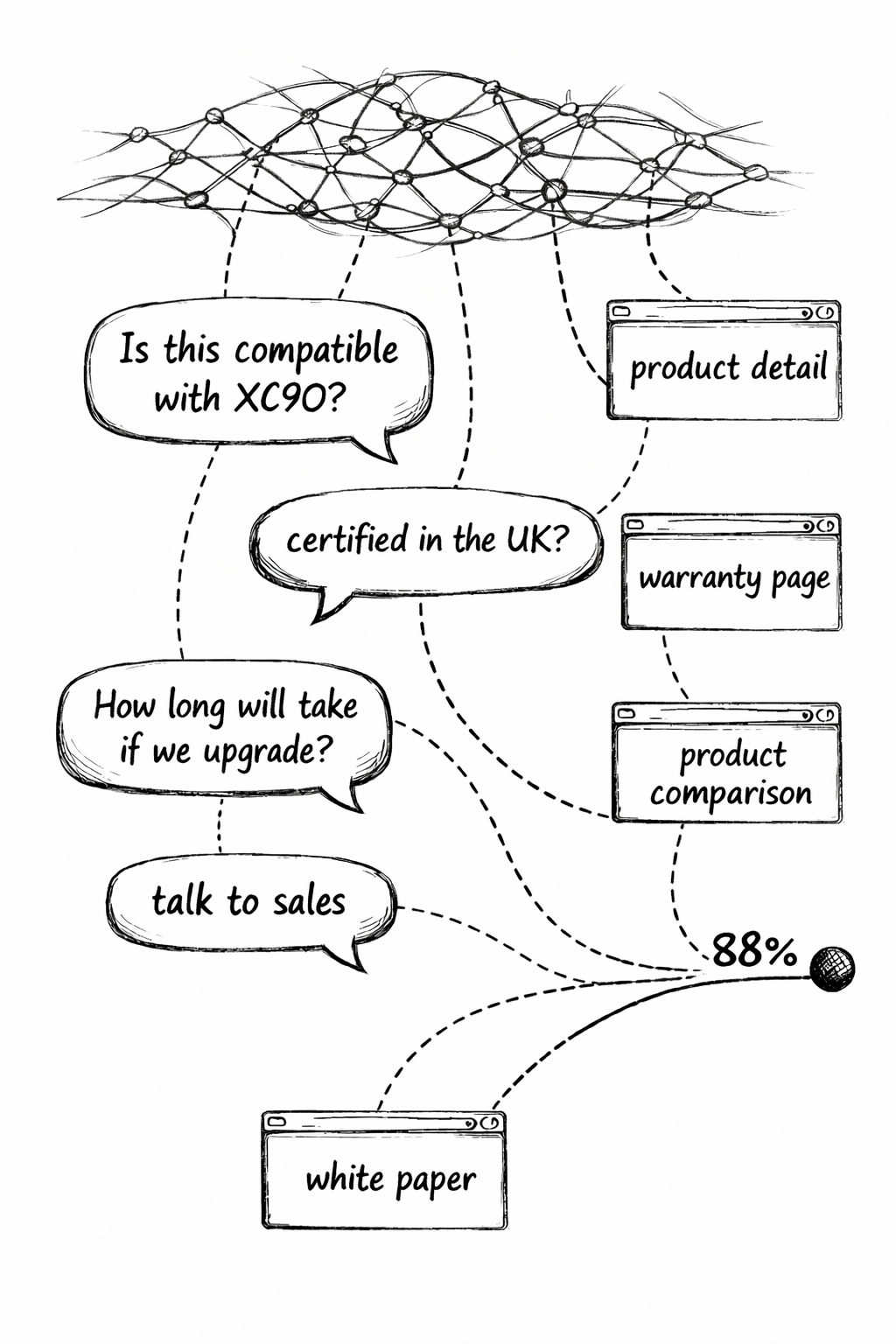
Prism ingests your entire knowledge base — pages, product catalogs, FAQs, technical documentation, legacy data sources — and answers the visitor's actual question first, with depth and citations. As the conversation develops, agentic playbooks written by your marketing team in plain language guide the dialogue from first question to first call, collecting qualifying information naturally through conversation rather than forms. A visitor who asks about a specific product line receives a different treatment than one comparing suppliers, and Prism distinguishes between the two without the visitor having to declare their intent.

When a visitor is ready for a handoff — whether to live chat or a scheduled meeting — the sales representative receives an intelligence package: conversation transcript, browsing history, collected context, and a lead score computed from real behavioral data. In one B2B enterprise deployment, this included a Bayesian network analysis layer that connected browsing patterns to historical sales outcomes and surfaced non-obvious signals. Visitors who viewed regulatory compliance documentation, for example, showed a disproportionately strong correlation with eventual sales qualification — a pattern that no traditional lead scoring model had identified. Read the full case study.

The result is leads worth taking and sales conversations that start with shared context rather than a cold introduction.

Talk to us about Lead Flow

Centralized AI Control

Prompt Management
Control the tone, depth, and scope of AI responses across Content Intelligence and Lead Flow through configuration tools inside AEM. Your brand voice is enforced at the model level, not patched on afterward.
Content Sourcing
Define precisely which site sections, document types, and data sources each Lift product can access. Sensitive content stays protected. The AI works only from what you explicitly authorize.
Guardrails
Built-in safeguards prevent hallucination by anchoring every AI output to source content. Token budgets and escalation paths are configurable to match your operational constraints.
Real-Time Analytics
Detailed breakdowns of lead engagement, visitor intent trends, search query patterns, and token usage are surfaced directly inside AEM — no separate dashboard to manage.

Let's Keep the Conversation Going

We enjoyed meeting you at Summit. Whether you saw something at our kiosk that you want to explore further, or you are earlier in the process and still figuring out where AI fits in your AEM roadmap, we are glad to talk. There is no obligation and no hard sell — just a practical conversation about what your team is trying to accomplish and whether Lift, Prism, or Metaphora might make it easier.

Let's Talk